Distributed Quantum Advantage
PI: Jukka Suomela · ERC Advanced Grant · October 2026–September 2031
Abstract
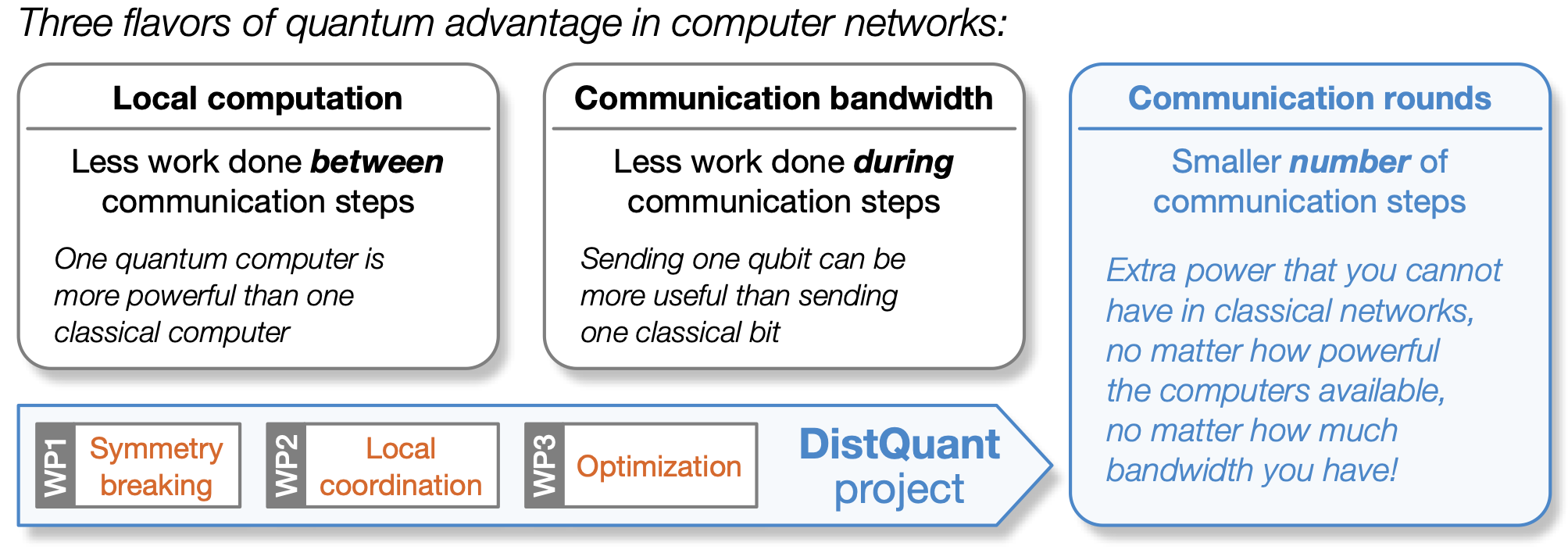
What tasks can be solved faster in large computer networks with the help of quantum computation and communication? This is the fundamental research question at the intersection of theoretical computer science and quantum information theory that I aim to understand in this project.
While the theory of quantum computing has a long and rich history, the theory of distributed quantum computing is still in its infancy. There are elementary distributed coordination tasks—for example, coloring of a cycle—that were well understood for classical algorithms already by the early 1990s, yet in 2025 we still have no idea if any of these tasks benefit from distributed quantum computing.
Very recently, my research group has made major advances in understanding the limits and capabilities of distributed quantum computing, in the context of the LOCAL model of distributed computing. We have shown that arguments based on causality and non-signaling distributions can be used to prove that a wide range of problems cannot admit distributed quantum advantage, while quantum games are a powerful tool for constructing local problems that do benefit from distributed quantum computing. Yet we have also discovered new barriers: known techniques cannot help us to tackle major open questions related to distributed symmetry breaking, local coordination, and optimization tasks. In this project, I aim to resolve these long-standing open questions. I aim to develop new frameworks and proof techniques that will let us resolve some of the biggest open questions of the field.
This project will shed light not only on the mathematical theory of distributed computing but also on the fundamental physical limits of large-scale information processing. While the work in this project is purely theoretical, I believe our new distributed algorithms will also serve as demonstrations and benchmarks that drive forward the development of practical quantum computers.
Funding
Funded by the European Union. Views and opinions expressed are however those of the author(s) only and do not necessarily reflect those of the European Union or the European Research Council Executive Agency. Neither the European Union nor the granting authority can be held responsible for them. This work is supported by ERC grant DistQuant (grant agreement No. 101266668).